The Tiny Seed- 1st Grade Flowers

The first graders created May Flowers inspired by the book The Tiny Seed- by Eric Carle using a variety of different media.

For the first part, we talked about looms and different ways to do weaving. Using a paper plate, the students used yarn and created the top part to our flower by weaving in a circular pattern going over and under each “petal”.

Students on the second day added the details to their flowers by adding a stem that had been covered with tissue paper and mod-podge. Also, we talked about pipe cleaners and how to create the leaves by creating V shapes by bending the wire inside.

The last part, the students could design their petals with glitter glue, crayons, and seeds found in the school garden. Also we talked about ways to cut their petals to make their flowers unique.

Here is their work!

-Ms. Samb

Naum Gabo Sculptures

3rd Graders explored the work of Naum Gabo and his role in the constructivist movement. During this time, artists wanted to focus on the materials they were using as well as started moving toward kinetic art (movement). There is a Naum Gabo sculpture just a few blocks away at the Chazen Art Museum on the UW campus.

After looking at some of his work & talking about his style of sculptures, students worked in a group at their table (4-6 students) and created a collaborative sculpture together. We created these sculptures right before Earth Day and focused on the idea of sustainability and reusing what we already had to create these sculptures (Cardboard rolls, box inserts, yarn, etc)

Once they were done, we spray painted them gold & white to resemble Gabo’s work.

They turned out great!

-Ms. Samb

Ideas May Shift – Artist and Randall mom Rachell Durfee at the Overture


Image

Linda is known for her calligraphy and design work:

ImageImageImage

Go check out this show!


Randall mom Rachel Durfee along with artist Linda Hancock are showing their work in Gallery II at the Overture Center. “These two artists are paired because of their sensitivity to media, the layering of artistic elements and the interplay of image and text. Durfee uses woodcut prints, paper constructions and poetry to illuminate and interpret “the internal psychological environment.” The selected images, from her butterfly series, reflect the seasons of life and contrast mankind’s creative and destructive powers with its ultimate frailty and powerlessness.  Hancock freezes “snippets” of text as an impetus for a deeper understanding of the meaning and the possibilities that the phrase evokes.  The paintings are meant to be intimate, with stray thoughts and musings woven into an abstraction of painting surfaces.” -Overture

April 9 – June 24, 2012

Reception:  Friday, May 4 6:00-8:00 pm 

Gallery Talks:  Sunday, May 13, 12:30-1:30 pm

Rachel Durfee:  12:30-1:00 pm

Linda P. Hancock:  1:00-1:30 pm

 Rachel is known for her handmade prints:

ImageImageImage


Opera for the Young’s FAMILY DAY!!

Sat, Jun 2
The Playhouse | 
Free
Shows at 1 & 1:30 PM
Running time: 1 hour

Join Opera for the Young for Family Opera Day featuring the world’s most popular children’s opera Hansel and Gretel. Come for preshow activities where your family can make costume/prop accessories, participate in a group voice lesson and learn the show’s choruses so you can sing along from your seats.  Opera for the Young is joined by staff from the Madison’s Children Museum and the Madison Youth Choirs for a wonderful day of operatic proportions.  The program is suitable for children ages 5 to 11.


Schedule of events:
11:30 AM – Art Lesson – Rotunda Stage
12:15 PM – Music Lesson – The Playhouse
  1:00 PM – Performance of Hansel and Gretel - The Playhouse

  2:00 PM – Art Lesson – Rotunda Stage
  2:45 PM – Music Lesson – The Playhouse
  3:30 PM – Performance of Hansel and Gretel - The Playhouse

Image

John Steuart Curry

The following excerpt is from www.mmoca.org.

John Steuart Curry, the celebrated American Scene painter, taught at the University of Wisconsin-Madison from 1936 until his death in 1946. While artist-in-residence, he was given commissions by the university and continued his own personal projects. Madison Landscape is a portrait of Wisconsin’s state capital. Seen from a high point overlooking the city, the white marble, gold-domed Capitol building is the focus of the landscape. It sits on a hill at the midpoint of an isthmus that connects Lakes Mendota and Monona. In the distance are the softly rolling hills of the countryside, washed in the colors of autumn that also tinge the leaves of the two trees that bracket Curry’s composition.

Although Curry works in a realist style, he takes liberties with nature. There is no hill quite so high in Madison. With the two foreground trees and hill slope, and with the branches and leaves of the tree to the right that overlap the white cumulus clouds, Curry frames Madison with nature. This may explain why the city and capitol building are so small relative to its setting. Curry connects humanity to the natural scheme of things—trees, lakes, beautiful sky, nurturing landscape, and the change of seasons—that embraces and protects a citadel for the noble seats of democratic government and learning.

John Steuart Curry, Madison Landscape, oil and tempera on canvas, 1941.

John Steuart Curry, Thomas Hart Benton, and Grant Wood were Regionalist painters. With the Social Realists, they composed the group of artists who defined American Scene Painting. This art movement, which prevailed during the Great Depression of the 1930s, sought to portray American life in traditional realist styles. The tone of their work could be lyrically nationalist or critical.

Born in Kansas, Curry studied at the School of the Art Institute of Chicago and in Paris. He taught in New York at the Art Students’ League but returned to the Midwest in 1936 to teach as artist-in-residence in the College of Agriculture at the University of Wisconsin-Madison. He continued to teach and paint there until his death in 1946 at the age of forty-nine. Free brushwork and energized forms characterize his realist style that poeticizes and celebrates the history and everyday life of his beloved Midwest.

Curry has many murals here in Madison located on the University of Wisconsin campus.

The Social Benefits of Biochemical Research

                          Freeing the Slaves

Randall third graders created their own class murals inspired by Curry’s Madison Landscape painting.

Each student drew their own building and person after practicing textures, patterns and gesture drawings.

Four of the five third grade classes participated. The fifth class was participating in Terrace Town at the time these were created.

Photos of the other three coming soon!

Jacob Lawrence

Jacob Lawrence (1917-2000) is a painter who is well known for documenting the great migration of free slaves from the south to the north. Lawrence lived in the New York neighborhood of Harlem in the 1920s. Lawrence was inspired by African American sculpture August Savage. He thought about the Great Migration in the 30s and decided to honor and record this event through his art. He spent months in the library researching historical events before he started his series on migration.

This panel is panel 57 of a woman doing laundry. She seems to be concentrating on her work with determination. We discussed this painting in depth. What do you know about the woman in this painting? What shapes do you see? What do the shapes represent?

Picturing America is a collection of posters given to schools around the country by a grant from the National Endowment for Humanities. This painting is part of that series. Picturing America posters come with a video, questions, information and lesson ideas for each image. Before starting our own paintings, we watched Picturing America’s video on Jacob Lawrence.

Then we discussed our own migration stories. Some students are first generation migrants while others’ families came to the US many generations ago. Each story is important to the make up of our community and each story deserves to be documented and told. So each student took their migration story and painted their own three panel of paintings just like Jacob Lawrence.

This is painting is by a student who just moved here from Russia this year.

Telling the Hmong migration story.

Irish migration.

African slave trade.

Some students either didn’t want to tell or didn’t know how to tell their migration stories so they painted a series on an important event in their life.

Wisconsin protests February 2011.

Music.

Students have relieved so many compliments on their beautiful paintings!

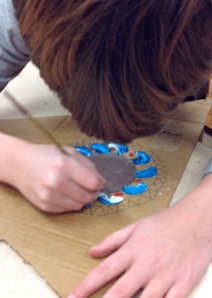
Circle Weaving & Mandalas

I am currently in my third year teaching at Randall. I’ve only done a lesson twice a few times and have enjoyed creating a new curriculum every year. I have started to look back on the projects I’ve done at all levels and decide which ones were the most successful. After evaluating them, I have started to put together a solid curriculum for next year based on students’ classroom curric and successful lessons I’ve done in the last few years.

Circle Weaving is a project I will most definitely be doing again. Overall, students LOVED circle weaving. It’s an inexpensive project that many students started doing at home because they loved it so much in class. I’ve never seen my classroom more consistently peaceful or more students focused all at one time than when they were circle weaving.

We began by looking at photos of Native Americans from Northern Wisconsin. The Bad River tribe and the Lac Courte Oreilles hold yearly celebrations for the harvest season, keeping alive their beautiful traditional dress, dances and music.

photos from Wisconsin Senator Bob Jauch

We discovered the many mandalas that are all over their traditional dress and talked about what mandalas mean. We also looked at mandalas from all over the world and discovered how mandalas are part of many cultures.

After looking at some of our Wisconsin tribes and cultures from all over, we created mandalas that represent us. Each student, after circle weaving, drew symbols around their weaving that represents them.

The mandalas also do a great job at brightening our hallways!


Congratulations Sebastian!

Congratulations to Randall 5th grader Sebastian Brauer!! Sebastian’s art work was given a blue ribbon at the South West Youth Art Month art show this last weekend. This means his art will move on to the Youth Art Month Capitol art show!

Go see Sebastian’s work and art work from students all over Wisconsin next month.

2012 WAEA Youth Art Month Capitol
Rotunda Exhibition
WAEA Youth Art Month (YAM) in the Capitol Rotunda will be celebrated March 18 – March 30th. Ceremony honoring PreK-12 artists will be held March 30th from 12 Noon -1:00PM. Awards sponsored by W.T. Graham, the DPI, Nasco, and Sax will given. The Capitol building hours are M-F 8a.m. – 6p.m. and on weekends/holidays from 8a.m. – 4p.m.


Follow

Get every new post delivered to your Inbox.

Join 1,197 other followers